

Best Advertising Networks for Startups in 2026
Most crypto projects that fail do not fail because of bad technology. They fail because nobody outside the founding team ever finds out they exist. If you are searching for the best advertising networks for crypto startups in 2026, you already understand the problem.
Global crypto ownership reached 741 million people last year, according to Crypto.com’s Global State of Crypto report, and the addressable audience keeps growing. But the mainstream advertising channels that other industries rely on remain largely closed to crypto. Google blocks token sales, DeFi protocols, and unhosted wallets. Meta requires written pre-approval, accepts roughly half of applicants, and still sweeps compliant accounts in automated takedowns. X (Twitter) has reopened crypto paid promotions, but only outside the EU, UK, and Australia.
Dedicated crypto ad networks fill that gap. They have built publisher relationships, targeting infrastructure, and compliance frameworks specifically for the Web3 space. But not all of them are equally trustworthy, equally capable, or equally suited to an early-stage startup with a limited runway.
This guide compares the platforms that matter most, covering their targeting capabilities, reach, formats, and the honest drawbacks that network marketing pages tend to omit.
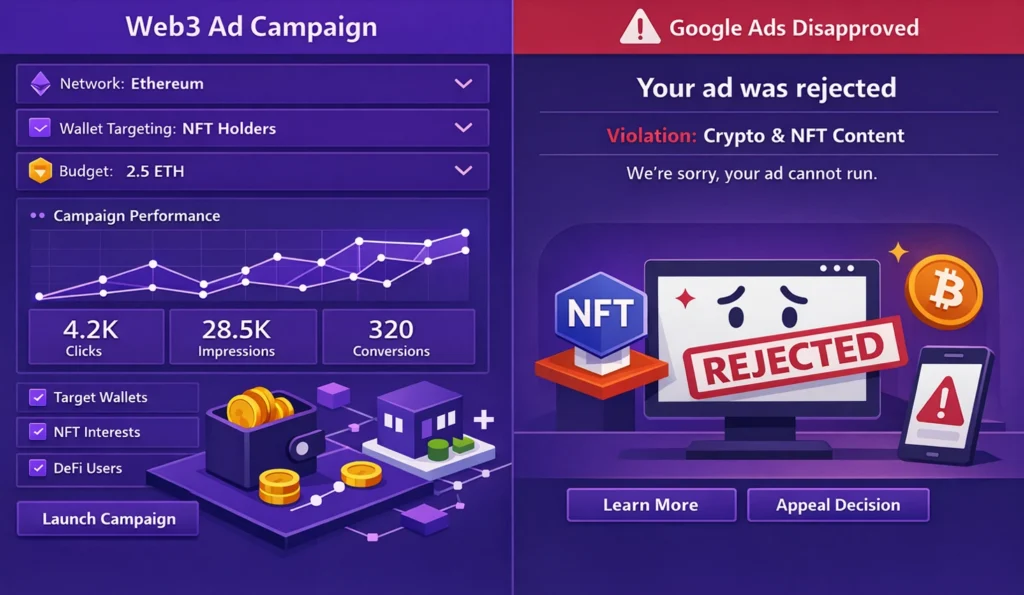
Caption: Crypto startups in 2026 navigate a paid advertising landscape where mainstream platforms still block most Web3 campaign types, making dedicated crypto ad networks the primary paid growth channel.
Why Google and Meta Are Still Off-Limits for Most Crypto Startups
The mainstream platform restrictions that shaped crypto advertising five years ago have not gone away. They have just become more complex.
Google permits ads from certified crypto exchanges, hardware wallets, and (in the US) coin trusts. Everything else, including DeFi protocols, token presales, DEX promotions, and most NFT projects, remains blocked. Even for permitted categories, the certification process takes 45 to 60 days on average and carries roughly a 40% approval rate, according to Google’s advertising policies for financial products. Compliant campaigns still get caught in automated review systems, and appeals can take weeks.
Meta requires written pre-approval and accepts advertisers holding one of 27 approved regulatory licenses across jurisdictions including the US, UK, EU, UAE, and Japan. The approval rate sits around 50%. NFTs, educational content, and storage-only wallets do not require pre-approval, but anything involving transactions or token economics does.
X (formerly Twitter) has been the most permissive major platform since removing crypto from its prohibited list in early 2025, but paid crypto promotions remain unavailable in the EU, UK, and Australia. That covers a significant portion of the most valuable crypto-native audiences.
The practical result: for most Web3 startups, the best advertising networks for crypto are not a backup plan. They are the primary channel.
Best Advertising Networks for Crypto Startups 2026: Five Platforms Compared
The following platforms have been evaluated on targeting capability, publisher quality, format options, reach, and available performance data. A note on that last point: virtually all published case studies in this space are self-reported by the networks or their agency partners. No independent auditor has verified industry-wide benchmarks. Where figures appear below, they are attributed to their source.
Coinzilla: Best for Premium Brand Awareness
Overview: One of the most established names in crypto display advertising, operating since 2016 with a manually curated publisher network.
Reach: 1 billion+ monthly impressions across 650+ vetted publisher sites.
Formats: Display banners, native ads, HTML5, pop-unders, sticky formats, press release distribution.
Targeting: Geo, device, browser, and site-level selection. No wallet-based or on-chain targeting.
Crypto payments: BTC, ETH, and 10+ others via CoinGate. KYC required.
Coinzilla’s main strength is placement quality. Every publisher is manually approved, and the network spans most of the major crypto media properties. Its Marketplace feature for sponsored articles and press releases adds editorial reach alongside display. User reviews on Trustpilot (105 total), sentiment mixed, include complaints about high CPC rates and friction when requesting refunds on unspent balances.
Best for: Established crypto exchanges and funded projects running brand-awareness campaigns on premium sites.
Bitmedia: Best for On-Chain Wallet Targeting
Overview: One of the broadest publisher networks in crypto advertising, operating since 2014 with AI-powered campaign optimization.
Reach: 1 to 1.5 billion monthly impressions across 5,000 to 7,000 publisher sites. Notable clients include Bybit, OKX, and Gate.io.
Formats: Display, native, text, HTML5, sticky, responsive, in-app, video, and Telegram placements.
Targeting: Geo, device, language, interest categories, frequency capping, VPN exclusion, and wallet activity targeting.
Bitmedia is among the best advertising networks for crypto startups that need wallet-level on-chain audience segmentation. That capability, combined with a low entry threshold and free banner design support, makes it one of the more practical choices for growth-stage projects. Trustpilot reviews (146, generally positive) support its traffic quality reputation.

Best for: Crypto projects wanting AI optimization, format variety, and wallet-level audience filtering without enterprise-level commitment.
Cointraffic: Best for Managed Campaigns with Dedicated Support
Overview: A mid-market network operating since 2014 from Tallinn, Estonia, with personal account management as a core differentiator.
Reach: 700 million monthly premium impressions across 600+ publishers including AMBCrypto and CoinMarketCap.
Formats: Display banners, native ads (notification alert and content-integrated), pop-unders, press release distribution to 65+ sites.
Targeting: Geo and device. No wallet-based or contextual interest targeting beyond publisher selection.
Every campaign on Cointraffic includes a dedicated account manager and free banner design. That personal service layer makes it particularly accessible for teams without an in-house media buyer. The limitations are real: ad approval takes 2 to 3 days, there is no weekend support, and there is no API access for automation.
Best for: Crypto projects wanting managed, premium placements with hands-on support and minimal setup friction.
AdsNetwork: Best for Web3 Startups with No Minimum Spend
Overview: A Web3-focused advertising platform positioning itself as an AI-powered multi-format network for crypto, DeFi, and NFT campaigns.
Reach: Claims 500 million+ users across 1,000+ Web3 and mainstream publishers including ABC News, Business Insider, and USA Today. IAB-certified and TAG brand safety standards stated.
Formats: Display, native, video, interstitial, HTML5, pop-under, and in-page push.
Targeting: 69+ pre-built audience segments, contextual and behavioral targeting. No minimum spend requirement.
AdsNetwork is purpose-built for Web3 campaigns and does not carry the compliance friction that makes mainstream platforms so difficult. The platform’s self-serve interface gives founders direct campaign control with no stated minimum spend, and a dedicated account manager is available for larger campaigns. Published case studies include a crypto project achieving a 38% wallet connection rate and 450+ monthly verified wallets. As one of the newer entrants among the best advertising networks for crypto startups 2026, independent third-party reviews are still limited, which makes running a structured test campaign the right first step before scaling budget.
Best for: Web3 startups at any stage wanting a crypto-native platform with no minimum spend, a clear DeFi and NFT focus, and a self-serve setup.
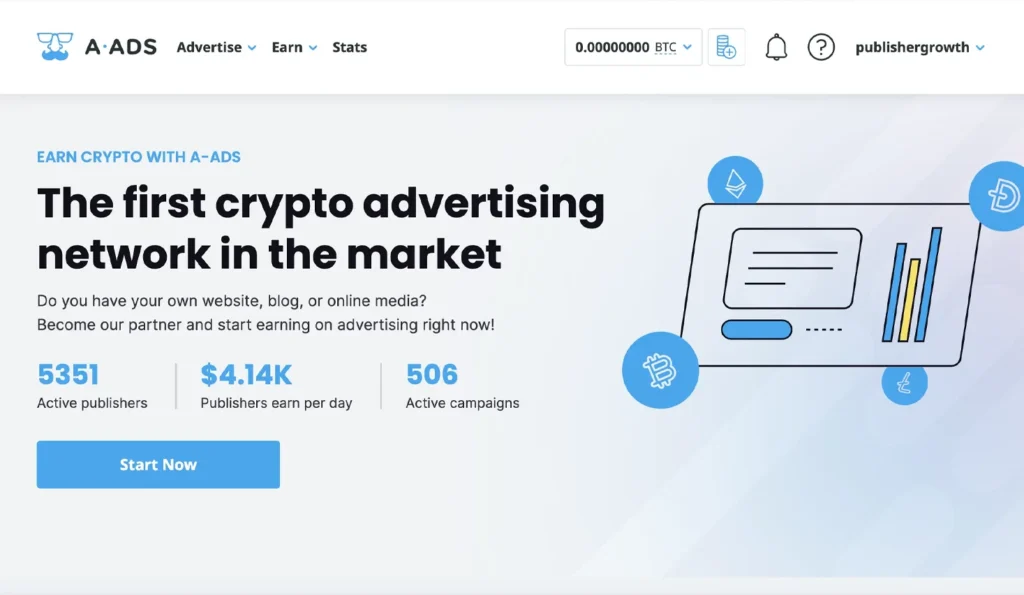
A-ADS: Best for Budget Testing and Emerging Markets
Overview: The oldest Bitcoin advertising network, founded in 2011, with a privacy-first architecture and a very accessible entry point.
Reach: 8.67 billion network-wide impressions. 16+ cryptocurrencies accepted including Lightning Network.
Formats: Banners, text, and basic video. No native, interstitial, or HTML5.
Targeting: Geo and broad site-category. No wallet-based targeting. No cookies or JavaScript.
A-ADS is one of the lowest-barrier entry points for a startup running its first paid test. The tradeoff is traffic quality. Multiple independent reviewers, including Coinbound’s analysis of crypto ad networks, have noted that A-ADS traffic does not always correlate with Google Analytics visits, suggesting a meaningful bot traffic component. Best approached as a test environment for creative validation, not a primary performance channel.
Best for: Creative testing and emerging market reach, particularly South and Southeast Asia. Not recommended as a primary performance channel.
Quick Comparison: Best Advertising Networks for Crypto Startups at a Glance
| Network | Impressions | Targeting | Formats | Best For |
| AdsNetwork | 500M+ claimed | Contextual, 69+ segments | Display, native, video, push, HTML5 | Web3 startups, DeFi, NFTs, no minimum |
| Bitmedia | 1-1.5B/mo | AI + wallet activity, on-chain | Display, native, Telegram, video | Wallet-level targeting, AI optimization |
| Coinzilla | 1B/mo | Geo, device, RTB, site-level | Banners, native, HTML5, PR, pop-under | Brand awareness, premium placements |
| Cointraffic | 700M/mo | Geo, device | Banners, native, PR distribution | Managed campaigns, dedicated support |
| A-ADS | 8.67B total | Geo, category only | Banners, text, basic video | Budget testing, emerging markets only |
Choosing the Right Crypto Ad Network: A Practical Framework by Stage
The most common mistake early-stage Web3 projects make with paid advertising is starting too broad. Splitting a test budget across three networks generates inconclusive data for all three. Starting focused generates learning.
Stage 1: Early testing. Use one network. Bitmedia or Cointraffic offer strong combinations of accessible entry points and verified traffic quality. Goal: identify which creative angle drives clicks. Do not scale until one creative shows clear signal.
Stage 2: Growth. Add a second format or second network once one creative shows consistent engagement. AdsNetwork is worth testing alongside a more established platform here. Goal: find what converts, not just what gets clicks. This is also a good stage to expand your crypto marketing budget planning.
Stage 3: Scale. Introduce native ads, sponsored content, or press release distribution alongside display. Coinzilla’s Marketplace or Cointraffic’s PR options give editorial credibility at this level. Pair this with your token launch marketing strategy for coordinated reach.
Stage 4: Full scale. Run multi-network campaigns with premium placements, performance-based buying on networks that offer CPA models, and ongoing creative testing. Goal: optimized full-funnel acquisition across display, native, and PR.
A few principles that hold at every level:
- Track on-site behavior, not just dashboard metrics. Time on page, wallet connections, and sign-up rates reveal actual user quality better than click-through rates alone.
- Test at least two creatives simultaneously. Single-creative tests produce misleading conclusions.
- Pair paid campaigns with active community channels. Traffic landing on a dead Discord or silent Twitter converts poorly regardless of targeting. See our guide on Web3 community building for context.
Frequently Asked Questions
How do I choose between self-serve and managed crypto ad networks?
Self-serve platforms, like AdsNetwork and Bitmedia, give you direct control over targeting, creatives, and budget allocation. They are better suited to teams with at least one person who understands paid media basics. Managed networks, like Cointraffic, assign a dedicated account manager who handles setup and optimization. That is a meaningful advantage for founders running campaigns alongside everything else on their plate. If you are comfortable building audience segments and reading campaign data yourself, self-serve gives you faster iteration. If not, a managed option reduces the chance of silent budget waste from a misconfigured campaign.
How do I evaluate whether a crypto ad network has quality traffic?
Dashboard metrics alone are not enough. Install your own analytics (Google Analytics or a privacy-preserving alternative like Plausible) and compare click counts against actual session counts. Quality traffic shows up as time on page, scroll depth, return visits, and conversion actions. Bot traffic clicks and bounces immediately. Ask networks directly how their anti-fraud infrastructure works and whether they can provide publisher-level breakdowns. Networks that refuse to share publisher-level data are a red flag. Request a refund policy for unspent budget in writing before committing.
Should I use one ad network or several simultaneously?
Start with one. Splitting a limited budget across multiple networks makes it harder to attribute results and impossible to optimize any single channel properly. Once one platform shows consistent conversion data, not just clicks, introduce a second to expand reach or test a different format. The most effective long-term approach typically pairs one display-focused network with one native or PR-focused option. That is a second-stage decision, not a starting point.
The Bottom Line on the Best Advertising Networks for Crypto in 2026
Crypto advertising in 2026 is genuinely more accessible than it was two years ago. Targeting capabilities have improved, format options have expanded, and the regulatory environment, while tightening in the EU and UK, has clarified rather than closed down what is possible.
The fundamentals have not changed: network choice still matters more than spend level, traffic quality varies wildly, and the gap between a good campaign and a wasted one almost always comes down to targeting precision and creative relevance.
The platforms in this guide cover a wide range of startup stages and campaign types. Start with the one that matches where you are today, track everything independently, and scale based on data rather than network marketing claims.
Evaluating crypto ad platforms for your next campaign? AdsNetwork is built specifically for Web3 campaigns, with no minimum spend and placements across crypto-native publishers. Worth comparing alongside the other platforms in this guide. See what fits at adsnetwork.io.
Ready to Get Started?
Launch your advertising campaign today and reach your target audience effectively.
Start Your CampaignAbout the Author
Hana Mori
Content specialist focused on digital advertising and marketing strategies. Passionate about helping businesses grow through data-driven campaigns.
Related Articles

How to Build a Winning Advertising Funnel
Here is the problem with most paid advertising campaigns: they treat every user the same. A cold audience sees the same ad as someone who spent ten minutes on your pricing page. The campaign looks active. The dashboard shows impressions and clicks. But conversions stay flat, and nobody can explain why. The answer is almost […]
11 min read
Retargeting Ads Strategy That Converts
Somewhere between 96 and 98% of the people who visit your website leave without taking any action. They read a page, check a price, look at a product, and disappear. Standard digital advertising treats those people as lost. A strong retargeting ads strategy treats them as your warmest leads, because that is exactly what they […]
13 min read

How to Optimize Ad Campaigns for Maximum ROI
Most ad budgets do not disappear in one bad decision. They erode slowly, spread across campaigns that were never truly dialed in: audiences that are too broad, creative that went stale months ago, landing pages that convert at half the rate they should, and attribution models that hide where the real money is going. To […]
12 min read