

Advertising Metrics Every Marketer Should Know
Most crypto projects launch ad campaigns with confidence. They set a budget, pick a network, hit publish, and then stare at a dashboard full of numbers they barely understand. The advertising metrics keep climbing. The results stay flat. If that sounds familiar, you are not alone. Knowing which advertising metrics actually matter, and how to read them, is what separates campaigns that grow communities from campaigns that burn budgets.
This guide covers the core metrics every Web3 marketer needs to track, what each one actually tells you, and how they apply to the unique reality of crypto advertising.
Why Advertising Metrics Matter More in Web3
Web3 audiences are skeptical by design. They have seen rug pulls, bot-inflated numbers, and vanity launches. That culture of distrust makes it even more important to measure what is real. Clicks can be faked and impressions can be purchased from low-quality traffic sources, but conversion events on-chain cannot be fabricated.
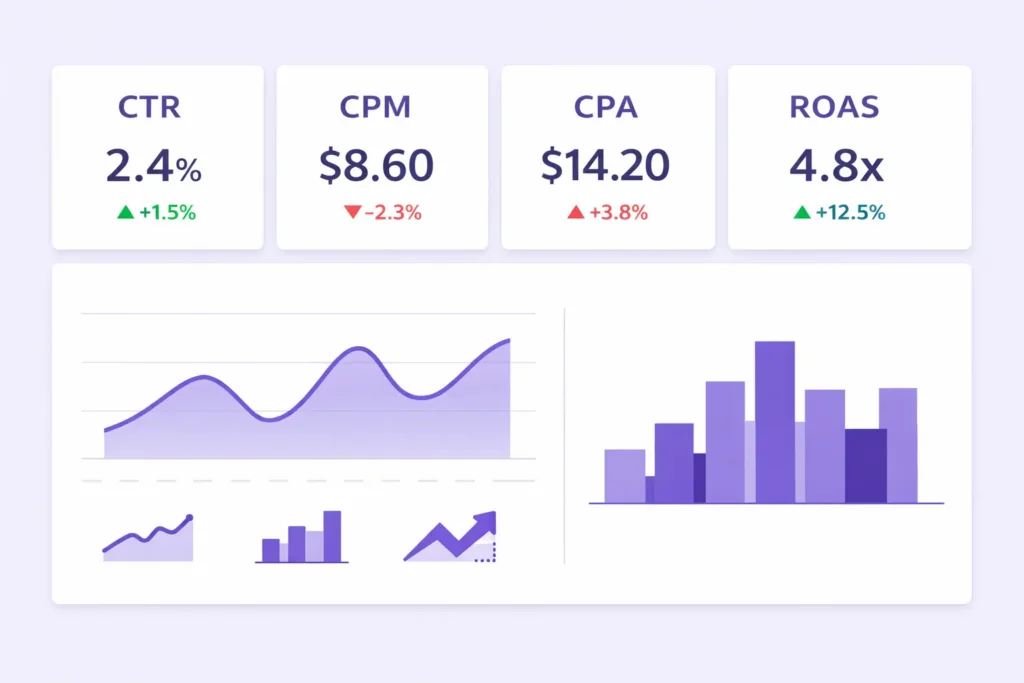
The good news is that Web3 marketing actually gives you more measurement opportunities than traditional digital advertising, not fewer. You have browser-based signals AND on-chain wallet data. That combination makes your advertising metrics sharper than anything available in Web2.
According to a recent industry analysis, organizations that actively track and analyze campaign performance are 2.3 times more likely to exceed their revenue goals. In crypto where competition for attention is fierce and ad budgets are often limited, that kind of edge matters.
The Core Advertising Metrics You Need to Track
CPM: Cost Per Mille
CPM, or cost per thousand impressions, is what you pay for visibility. Every time your ad is shown to 1,000 people, you pay the CPM rate. This metric tells you how efficient your reach is, not how effective your message is.
General display advertising averages around $2-$5 CPM across mainstream networks. Crypto-focused ad networks charge significantly more, often $3-$22 CPM, because the audiences are specifically interested in blockchain products. A higher CPM is not always a problem. Paying more for a crypto-native audience that is likely to convert is usually better than buying cheap impressions from users who have no interest in DeFi.
If you are running awareness campaigns, CPM is your primary cost benchmark.
CPM is also the standard pricing model in programmatic advertising, which now accounts for roughly 90% of all display ad spend globally.
CTR: Click-Through Rate
CTR measures how many people who saw your ad actually clicked it. The formula is simple: clicks divided by impressions, multiplied by 100.
Display ad benchmarks are low. The average CTR for display ads across all industries sits around 0.46%. For search ads, it climbs to around 6.64%. This gap matters because crypto projects often mix up formats and then judge performance using the wrong benchmark.
A low CTR usually points to one of three problems:
- Your creative is not resonating with the audience
- Your targeting is off and you are reaching the wrong people
- Your ad format is not suited to the placement
In Web3, a CTR above 0.5% for a display campaign is a reasonable signal that your creative and targeting are working. Use it as a directional metric, not an absolute grade.
CPC: Cost Per Click
CPC tells you what you pay every time someone clicks your ad. It is a core pricing model for search and social platforms. A lower CPC generally means you are paying less to drive traffic, but CPC alone means nothing without knowing what happens after the click.
On Facebook, the average CPC sits around $1.06 across industries. Crypto verticals typically run higher because of increased competition and platform policy friction, which pushes many blockchain projects toward dedicated crypto ad networks instead.
If your CPC is high but your conversion rate is also high, you may actually be getting a good deal. The number that matters is cost per acquisition, which we will cover next.
Conversion Rate and CPA
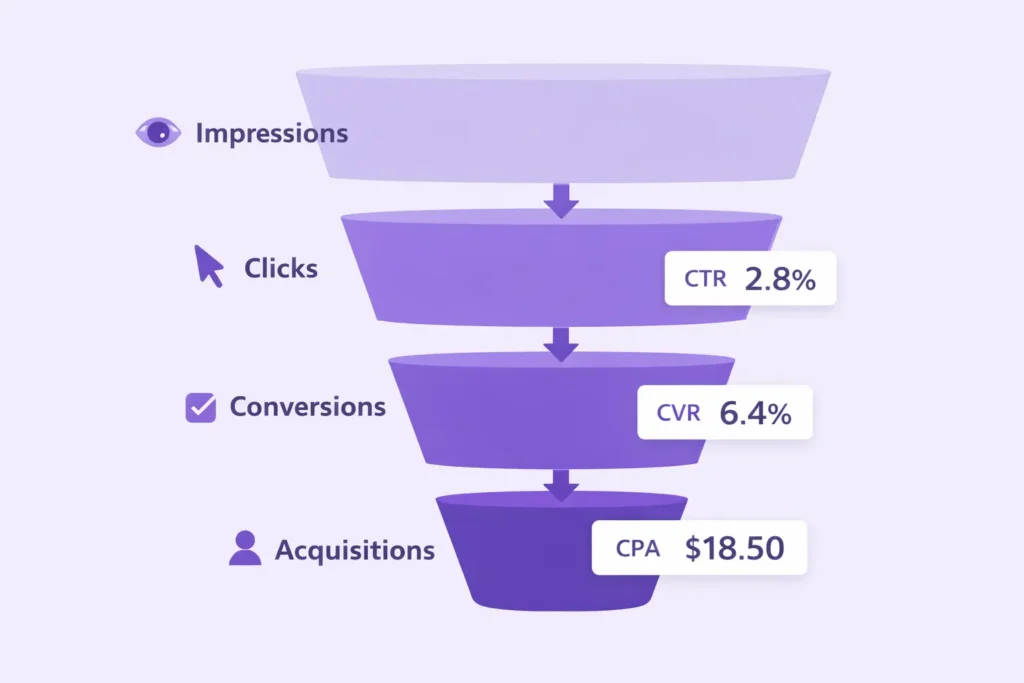
Conversion rate is the percentage of clicks that result in a desired action: a wallet connect, a sign-up, a token purchase, or a deposit. CPA, or cost per acquisition, takes this one step further and tells you the total cost to generate one conversion.
These two advertising metrics work as a pair. A high conversion rate lowers your CPA. A low conversion rate means you are paying for clicks that lead nowhere.
For Web3 campaigns, the conversion event you define matters enormously. A wallet connection is a much stronger signal than a newsletter sign-up. A completed trade or deposit is stronger than either. Be specific about what counts as a conversion before you launch.
According to data from CXL, the average conversion rate for display ads across industries is around 0.9-1.3%. Retargeted ads can perform three to four times better than standard display, which is why retargeting crypto audiences who have already visited your site or connected a wallet is one of the most efficient strategies available.
ROAS: Return on Ad Spend
ROAS is the closest thing to a profit metric you will find in your advertising dashboard. It measures how much revenue you earn for every dollar you spend on ads. A ROAS of 3x means you are generating $3 in revenue for every $1 spent.
A ROAS between 3 and 5 is typically considered healthy for most industries, according to WebFX benchmarking data. Then a ROAS below 2 suggests your campaigns may not be profitable once all costs are factored in.
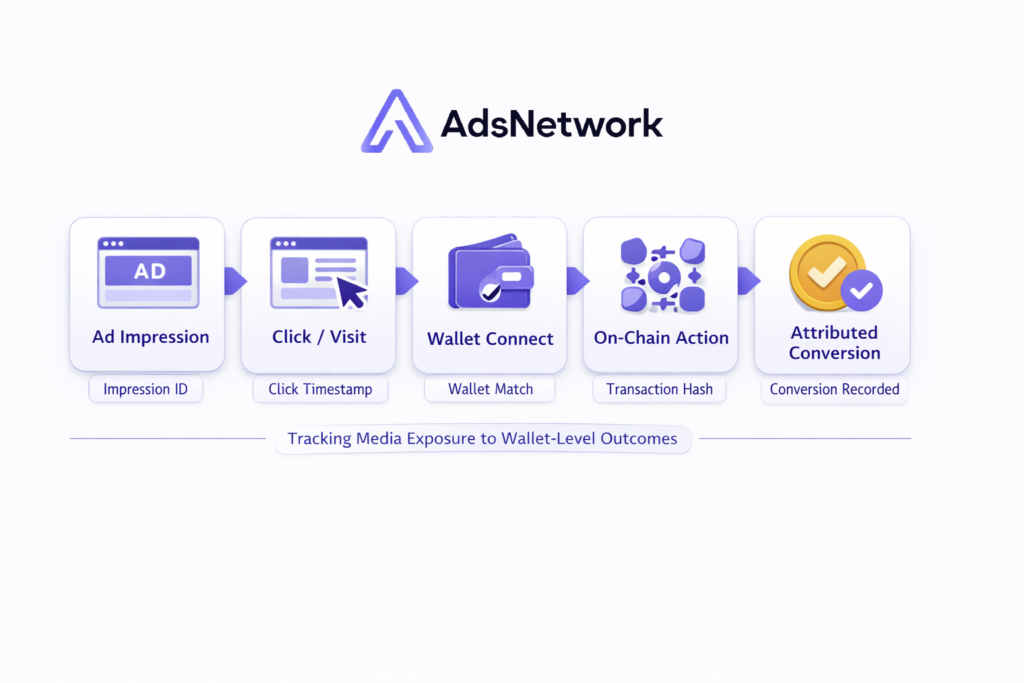
For Web3 projects, you can also calculate your ROAS using on-chain data: tracking the dollar value of swaps, fees, or token activity generated by wallets your campaign brought in. This approach produces a much more honest number than relying purely on browser-based attribution. Use it alongside standard ROAS to get a complete picture.
Two Metrics That Web3 Marketers Often Overlook
Viewability Rate
An impression is only worth something if the ad was actually seen. Viewability rate measures the percentage of your ads that were visible on screen for at least one second (two seconds for video). Industry standards set by the Interactive Advertising Bureau define a viewable display ad as 50% of the pixels visible for one second or more.
If your viewability rate is low, you are paying for impressions that no one ever saw. This is a common issue on low-quality traffic networks. When evaluating a Best Advertising Networks for Crypto and Web3 Startups in 2026, ask for viewability reporting before you commit budget.
Fill Rate
Fill rate is primarily a publisher metric, but advertisers running campaigns across multiple placements should understand it. It measures the percentage of ad requests that actually result in an ad being shown.
For publishers on AdsNetwork, maintaining a high fill rate means more of your ad inventory is being monetized. For advertisers, a network with strong fill rates signals healthy demand and consistent placement quality across the sites you are paying to appear on.
The Web3 Metric Changing How Crypto Campaigns Are Measured
A growing number of Web3 marketing teams now track CPW, or cost per wallet. It is the crypto-native equivalent of cost per click, but instead of measuring browser-based clicks (which can include bots and unqualified traffic), CPW measures the cost to get a real, verified wallet to visit your site or take an action.
The case for CPW is compelling. According to Addressable, some campaigns have achieved a CPW as low as $1.86, with most acquired users completing a transaction within 72 hours of clicking. That is meaningful engagement. Compare that to a campaign showing 100,000 clicks on a standard dashboard with only three wallets ever making a swap. CPW cuts through the noise.
Platforms built for Web3 advertising, including AdsNetwork, are designed to help teams track these wallet-level signals alongside traditional advertising metrics, giving a more complete view of what a campaign is actually achieving.
How to Use These Advertising Metrics Together
The mistake most teams make is optimizing for a single metric in isolation. A great CTR means nothing if your conversion rate is 0.1%. A low CPA looks excellent until you realize the acquired users churn within a week.
The smartest crypto marketing teams treat advertising metrics as a system. Start at the top of the funnel with CPM to control reach costs. Move to CTR to verify your creative is connecting with the right people. Then track conversion rate and CPA to understand post-click quality. Finish with ROAS to tie everything back to revenue.
For Web3 campaigns specifically, layer in on-chain data wherever possible. Wallet connections, transaction volume, and token activity give you signals that browser analytics simply cannot provide.
AdsNetwork is built for exactly this kind of layered measurement. The platform connects display and native ad delivery with reporting tools designed for Web3 publishers and advertisers who need real transparency, not just impressive-looking dashboards.
Start Measuring What Actually Matters
Most campaigns fail not because the product is wrong, but because the team was measuring the wrong things. Advertising metrics are not just reporting tools. They are the signal system that tells you where to push harder and where to cut. Get these right and every dollar you spend becomes more intentional.
If you are ready to run crypto and Web3 campaigns against audiences that actually convert, explore what is available at adsnetwork.io.
Frequently Asked Questions
What is the most important advertising metric for a Web3 project?
There is no single most important metric, but ROAS and CPA are the closest to a bottom-line answer. ROAS tells you how much revenue your spend is generating. CPA tells you what it costs to acquire each customer or wallet. For early-stage projects focused on community growth, conversion rate and CPW (cost per wallet) are often more meaningful than revenue-focused metrics.
What is a good CTR for crypto display ads?
Display ad CTR benchmarks are generally low across all industries, with averages around 0.46%. For crypto-native placements, a CTR of 0.5% or above is a reasonable indicator that your creative and targeting are aligned. Retargeted ads typically perform three to four times better than standard display, so segmenting warm audiences is worth the extra setup.
How is CPM different from CPC in crypto advertising?
CPM (cost per mille) is what you pay for impressions, meaning visibility. CPC (cost per click) is what you pay for traffic. CPM campaigns are best for awareness goals where you want to get your project in front of as many targeted users as possible. CPC campaigns are better when you need direct traffic to a landing page or minting site. Most experienced crypto marketing teams use both, depending on where a user sits in the conversion funnel.
Ready to Get Started?
Launch your advertising campaign today and reach your target audience effectively.
Start Your CampaignAbout the Author
Ana Collins
Content specialist focused on digital advertising and marketing strategies. Passionate about helping businesses grow through data-driven campaigns.
Related Articles
Retargeting Ads Strategy That Converts
Somewhere between 96 and 98% of the people who visit your website leave without taking any action. They read a page, check a price, look at a product, and disappear. Standard digital advertising treats those people as lost. A strong retargeting ads strategy treats them as your warmest leads, because that is exactly what they […]
13 min read

How to Optimize Ad Campaigns for Maximum ROI
Most ad budgets do not disappear in one bad decision. They erode slowly, spread across campaigns that were never truly dialed in: audiences that are too broad, creative that went stale months ago, landing pages that convert at half the rate they should, and attribution models that hide where the real money is going. To […]
12 min read

How to Increase ROAS in Digital Advertising
Most campaigns do not fail because the product is wrong or the budget is too small. They fail because the return on ad spend never gets high enough to justify scaling. If you’re looking for ways to increase ROAS, it’s important to realise that low ROAS is not a budget problem. It is a signal […]
11 min read