
Your banner ad just served 10,000 impressions and earned exactly 12 clicks. That is the reality of standard mobile banners, which average a CTR of just 0.10% to 0.30%. Mobile interstitial ads, in contrast, deliver CTR rates of 0.50% to 1.50% or higher. That is up to five times the engagement from a single format change.
According to Epom, mobile interstitial formats consistently reach 1.5% CTR. Standard leaderboard placements average just 0.1% in the same environments. Full-screen mobile ads are not just bigger. They are fundamentally more effective. This guide explains how mobile interstitial ads work, why they outperform every other mobile format, and how to use them to drive real conversions.
What Are Mobile Interstitial Ads?
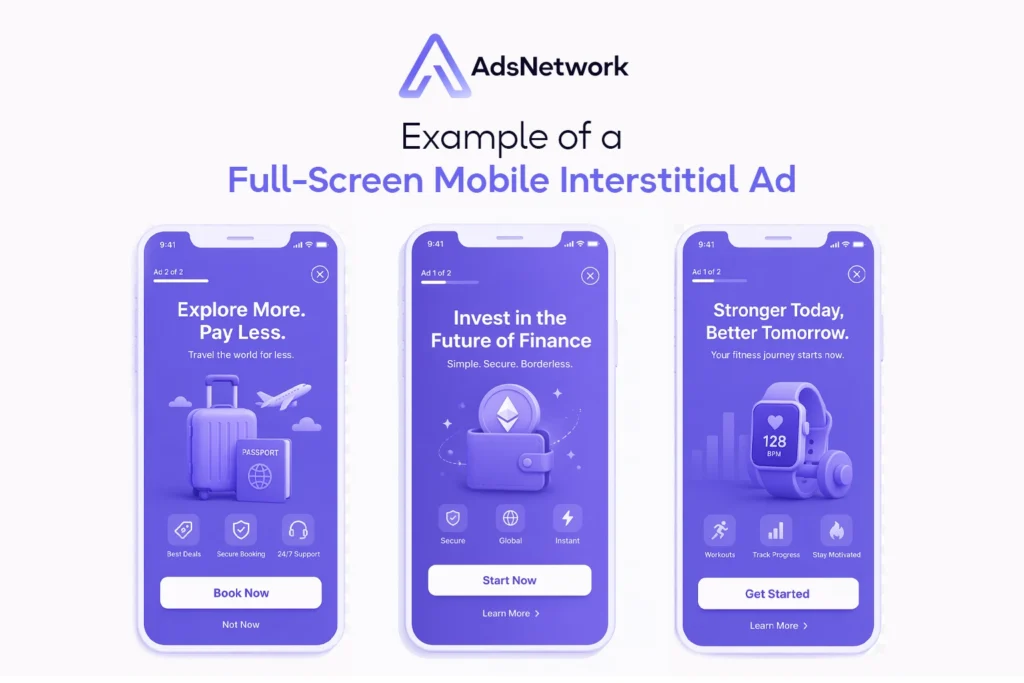
Mobile interstitial ads are full-screen advertisements that cover 100% of a device’s display. They appear at natural transition points within an app or website. According to Business of Apps, these ads have become one of the most popular formats alongside rewarded video. The format supports multiple creative types:
- Static images: single full-screen visuals with a clear CTA, minimal load time, can be closed immediately
- Video interstitials: short clip plays before the close button appears, typically after five seconds
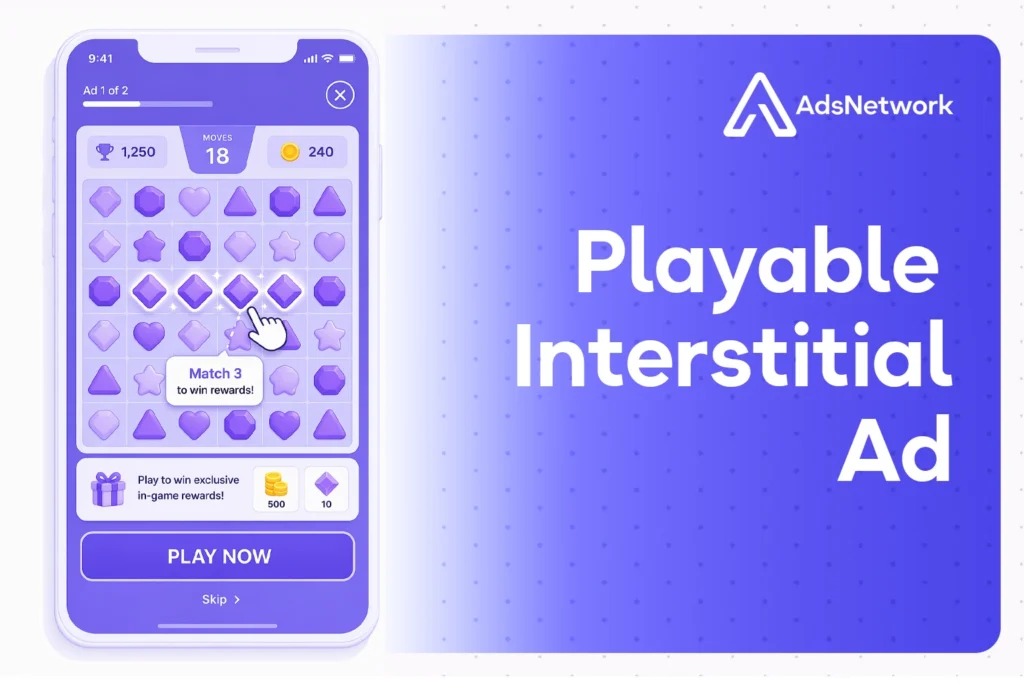
- Playable interstitials: users interact with a mini-demo for 30 to 60 seconds before taking action
- Rich media HTML5: interactive elements, animations, and embedded CTAs in a full-screen environment
Unlike banner ads that sit passively at screen edges, interstitials demand full user attention. After viewing the ad, users either engage with it or close it and return to their content. This creates a clear decision point that drives higher engagement than passive formats.
Moreover, full-screen mobile interstitials achieve approximately 98% viewability, according to Marketing LTB. In comparison, standard display ads average just 65% to 70% viewability. A large portion of banner impressions are therefore essentially wasted spend before any targeting or creative consideration is applied. For advertisers optimizing cost per genuine impression, the viewability gap alone makes interstitials the more efficient starting point.
Mobile Interstitial Ad Formats in Detail
Static and Video Interstitials
Static interstitials display a single full-screen image with a clear CTA. Users can close them immediately, making this the least intrusive option. They load quickly and work well for awareness campaigns and direct-response offers where the message fits a single visual.
Video interstitials play a short clip before offering a close button. These capture more attention because motion is harder to ignore than a static image. However, they require higher production investment and must load quickly to avoid user abandonment. For crypto and gaming campaigns, a 15-second video walkthrough often communicates more than any static graphic could.
Playable and Rich Media Interstitials
Playable interstitials are the premium tier. They let users interact with a mini-demo for 30 to 60 seconds before taking action. According to Yango Ads, playable formats command CPMs between $15 and $25 because users actively engage rather than passively watch. Gaming apps benefit most from this format. However, app previews and feature demonstrations also work well across fintech and DeFi categories.
Why Mobile Interstitial Ads Outperform Banners
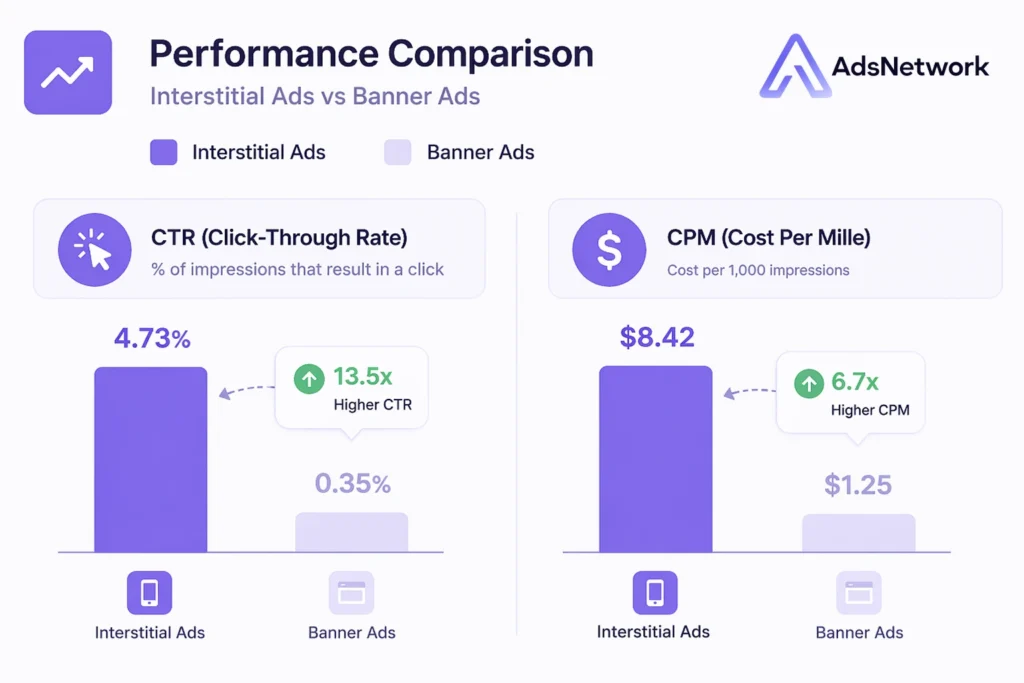
The performance gap between interstitials and banners is not marginal. It is dramatic. According to Adapty, full-screen placement results in CTRs of 4% to 5% on Android devices. Standard banner ads average just 0.1% to 0.3%. Additionally, research analyzing over 270,000 consumers shows interstitial formats generate CPM rates approximately 71% higher than banner placements.
The reason is straightforward. Banner blindness has conditioned users to ignore small ad units at the top or bottom of their screens. Interstitials fill the entire display at natural pause points. Consequently, every impression has genuine visibility and engagement potential that passive banner formats simply cannot match.
Real-world results confirm this advantage. According to inBeat, Pinterest and Airbnb both optimized their interstitial strategies and saw app installation rates jump by 100% and 300% respectively. These are measurable business outcomes from companies investing in full-screen mobile advertising.
Mobile Interstitial Ads Performance Benchmarks
Setting realistic benchmarks helps you evaluate campaign performance and optimize effectively. Here are the key metrics every advertiser should track.
CTR and Conversion Rates
Well-timed, high-quality interstitials commonly land in the 0.5% to 1.5% CTR range. Highly targeted or incentive-based formats can exceed 2% to 3%. According to Business of Apps, interstitial ads show the highest rates of in-app conversion: over 20% on Android and close to 15% on iOS. These conversion rates far exceed what standard display formats deliver.
CPM and Revenue Benchmarks
Interstitial eCPMs in the United States reached $14.32 on iOS and $14.08 on Android in Q4 2024, according to Adapty. Those figures are roughly 20 times higher than banner ad rates in the same markets. Meanwhile, Business of Apps reports that interstitial CPMs grew from $3.00 in 2019 to $4.80 by 2024, confirming a consistent upward trend. For advertisers, these premium rates reflect the format’s ability to deliver genuine user attention.
Best Practices for Mobile Interstitial Ads
The power of interstitials comes with responsibility. A poorly timed full-screen ad can frustrate users and damage retention. Here is how to maximize performance while protecting user experience, which ultimately determines whether interstitials help or hurt your mobile growth metrics.
Timing: When to Show Interstitials
Timing is the most critical variable in interstitial campaign performance. Specifically, always place interstitials at natural breakpoints. The right moments include:
- Between game levels or rounds, after a task is completed
- During page or screen transitions in content apps
- After a user has successfully completed an action such as a sign-up or level clear
- During natural pauses in a session, not while users are actively interacting
Google penalizes apps that show interstitials at app launch or that block critical content, as noted by Yango Ads. In particular, never show interstitials during loading screens or immediately after opening the app. An interstitial that appears at the wrong moment turns a high-engagement format into a user retention problem.
Frequency Capping: Protecting User Experience
Frequency capping is as important as timing. Even well-designed interstitials become irritating when shown too often. Industry best practice limits interstitial ads to one per session or one per several user actions. According to Adapty, starting conservatively and increasing frequency only when analytics confirm stable engagement is the safest approach.
Specifically, monitor these signals after any frequency change:
- Uninstall rate: a spike within 48 hours of increasing frequency signals user frustration
- Session length: declining average session length indicates the ad experience is degrading retention
- Day-7 and day-30 retention: these cohort metrics reveal whether frequency changes affect long-term user behavior
- CTR trend: a falling CTR on the same audience over time signals frequency fatigue, not creative failure
Therefore, treat frequency as a dynamic variable rather than a fixed setting. The optimal cap differs by user segment, app category, and session length. Consequently, the right frequency for a casual gaming app is very different from the right frequency for a DeFi portfolio tracker.
Creative and Compliance Optimization
Strong creative drives strong results. Video interstitials outperform static formats because motion captures attention more effectively in a full-screen environment. Similarly, ads with clear close buttons and fast load times maintain user trust while maximizing engagement.
Compliance also matters significantly. Google and Apple both enforce strict guidelines on interstitial placement and behavior. Ads must include easily accessible close buttons, and they must not appear in ways that trick users into clicking. Because accidental clicks inflate CTR without delivering real conversions, maintaining compliance protects both user experience and campaign accuracy.
A/B Testing for Continuous Improvement
Running a single interstitial creative is the most common mistake in mobile advertising. Instead, launch with at least two to three variations per campaign: test different images or video lengths, different headline copy, and different CTA button colors or text. Because interstitials generate high impression volume relative to standard display placements, meaningful statistical data accumulates quickly, sometimes within 48 to 72 hours on well-trafficked apps.
Furthermore, test timing variations separately from creative variations. Changing both simultaneously makes it impossible to identify which variable is driving performance changes. A structured test isolates one variable at a time, producing insights that improve every subsequent campaign rather than one-off results. Additionally, save your best-performing creative combinations as benchmarks to measure future tests against, building an institutional record of what works for each specific audience segment.
Mobile Interstitial Ads for Crypto and Web3 Projects
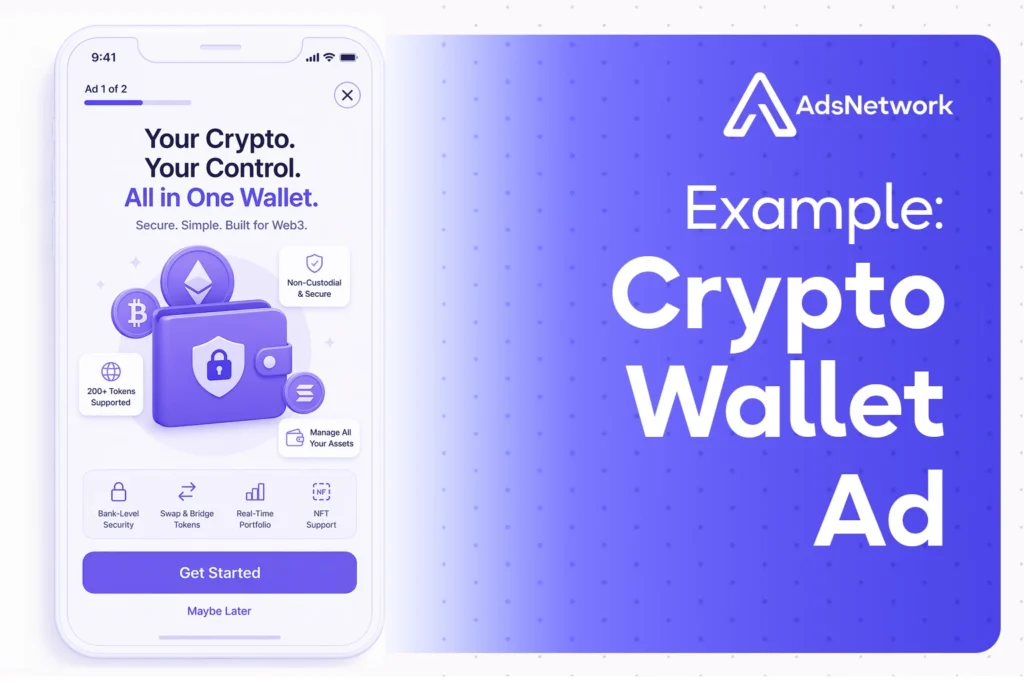
Crypto projects need ad formats that demand attention in a space crowded with noise. Token launches, wallet promotions, and DeFi onboarding campaigns all benefit from full-screen formats that communicate complex value propositions quickly. Because mobile interstitial ads capture 100% of the screen, they give crypto advertisers the space to explain their product rather than compete for a tiny banner slot.
The Web3 audience spends significant time in mobile apps, from portfolio trackers to decentralized exchanges. Interstitial placements at natural transition points within these apps reach users who are already engaged with blockchain products. As a result, the format delivers higher relevance and stronger conversion potential than banner ads placed on general news sites. For DeFi protocols specifically, a well-timed interstitial after a wallet connection event can drive staking or liquidity actions at the moment users are most ready to engage.
| Ready to run mobile interstitial campaigns? Explore AdsNetwork’s mobile interstitial ad solutions and start reaching engaged mobile audiences with full-screen formats that convert. |
Converting with Mobile Interstitial Ads
Mobile interstitial ads are the highest-impact format available to mobile advertisers today. The numbers are clear: 98% viewability, up to 5x higher CTR than banners, in-app conversion rates of 15% to 20%, and CPMs that reflect genuine user attention. Advertisers who combine strategic timing, disciplined frequency capping, and strong creative consistently see the strongest results.
For crypto and Web3 projects, interstitials offer the full-screen real estate needed to explain complex products in seconds. Whether you are driving wallet downloads, promoting a token launch, or onboarding DeFi users, this format delivers the engagement that smaller formats cannot match. Start running high-impact campaigns today at AdsNetwork Mobile Interstital.
Frequently Asked Questions
What CTR can I expect from mobile interstitial ads?
Well-timed interstitials typically achieve CTRs between 0.5% and 1.5%. Highly targeted formats can exceed 2% to 3%. On Android devices specifically, full-screen placements can reach 4% to 5% CTR. In comparison, standard mobile banners average just 0.1% to 0.3%. The format’s viewability advantage, at 98% versus 65% to 70% for banners, also means more impressions are genuinely seen before any click decision is made.
When should mobile interstitial ads appear in an app?
Interstitials should only appear at natural transition points, such as between game levels, after completing a task, or during page navigation. Never show them at app launch, during loading screens, or while users are actively engaged with content. Proper timing protects user experience while maximizing engagement. Consequently, interstitials placed at the wrong moment convert less and damage retention more than almost any other ad placement mistake.
Are mobile interstitial ads effective for crypto advertising?
Yes, interstitials are well-suited for crypto projects because they provide full-screen space to explain complex products like DeFi protocols or token mechanics. The format reaches users in crypto apps during natural breaks, delivering higher relevance than standard display. Therefore, many Web3 advertisers include interstitials as a core part of their mobile acquisition strategy alongside native and display placements.
Converting with Mobile Interstitial Ads
Mobile interstitial ads are the highest-impact format available to mobile advertisers today. The numbers speak clearly: 98% viewability, up to 5x higher CTR than banners, and CPMs that reflect genuine user attention. Specifically, advertisers who combine strategic timing, frequency capping, and strong creative are seeing the strongest results.
For crypto and Web3 projects, moreover, interstitials offer the full-screen real estate needed to explain complex products in seconds. Whether you are driving wallet downloads, promoting a token launch, or onboarding DeFi users, mobile interstitial ads deliver the engagement that smaller formats cannot match.
Start running high-impact interstitial campaigns today. Explore formats, launch campaigns, and track results at AdsNetwork.
Featured Posts
Oct 23, 2026
10 min read
What Is CPM in Advertising? Meaning, Formula and 2026 Rates
CPM is the cost an advertiser pays for 1,000 ad impressions, making it one of the most common…
Read Article
Sep 23, 2026
6 min read
What Is Advertising Technology (AdTech) and How Does It Work?
Advertising technology, commonly known as AdTech, refers to the software, platforms, tools, and systems used to plan, buy,…
Read Article
Sep 16, 2026
8 min read
Media Buying: A Complete Guide for Advertisers
Media buying is the process of purchasing advertising space to reach a target audience. It includes choosing where…
Read ArticleNeed Help?
Our team is ready to help you launch successful campaigns.
AI-Powered Mobile
Monitor Your Campaigns Anywhere
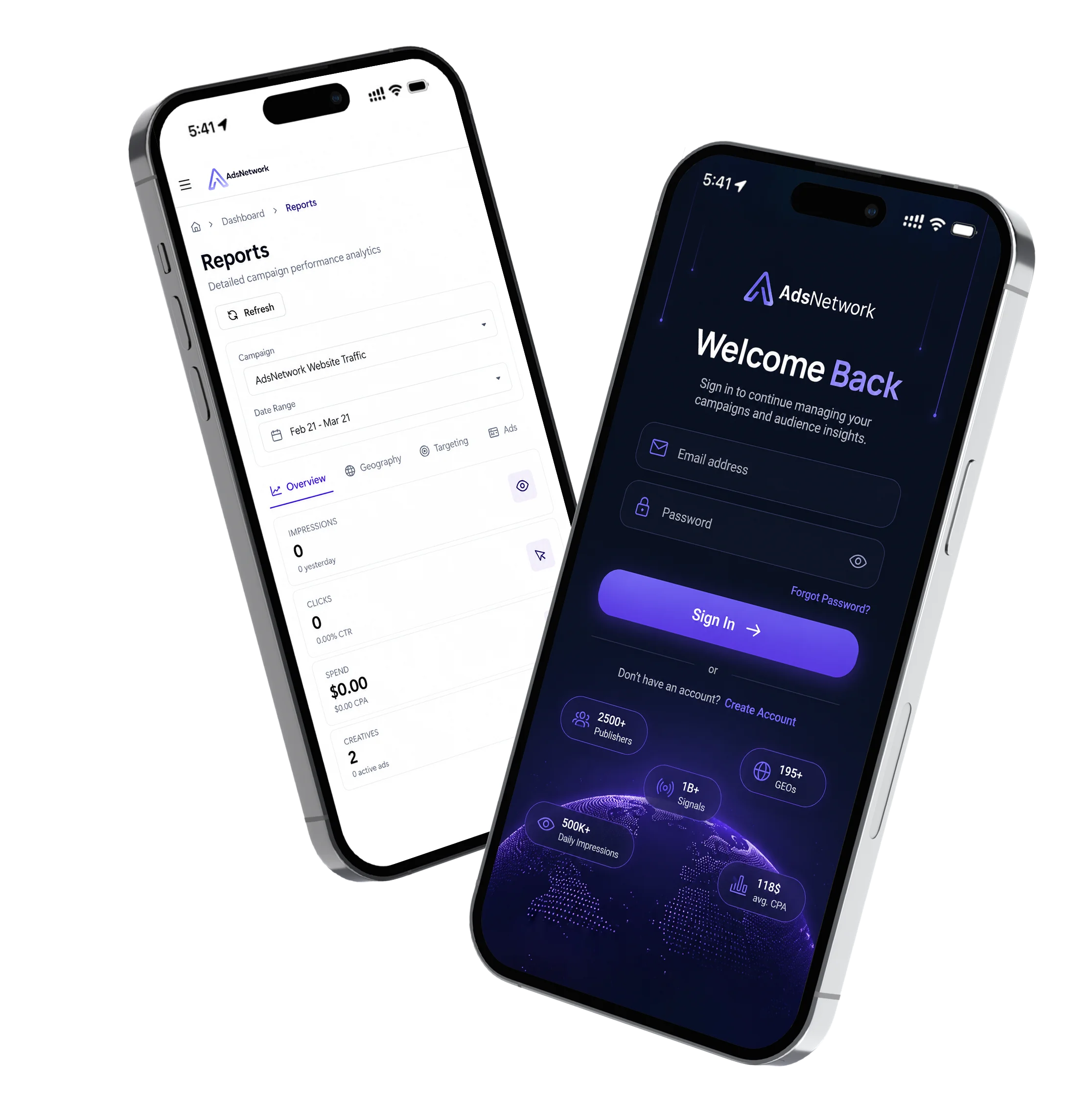
Stay connected to your live AdsNetwork campaigns with our mobile advertising app. Track impressions, clicks, conversions, campaign spend, and overall performance in real time—anytime, anywhere. Available for iOS and Android.