

Every day, billions of digital ads appear across websites, apps, and decentralized platforms. However, behind each impression sits a system most people never see. Understanding how ad networks connect advertisers and publishers is essential for anyone spending money on digital campaigns or monetizing content. Without this knowledge, you risk wasting budget on the wrong placements. Similarly, publishers risk leaving revenue on the table.
The digital advertising industry is massive. According to Marketing LTB, global digital ad spending reached $740 billion in 2025. In addition, programmatic transactions now power over 90% of all display ad purchases, as confirmed by the IAB’s 2025 Digital Advertising Revenue Report. Yet many marketers and publishers still struggle to understand the actual mechanics behind these transactions. Therefore, this guide breaks down how ad networks connect advertisers and publishers, step by step.
How Ad Networks Connect Advertisers and Publishers: The Core Model
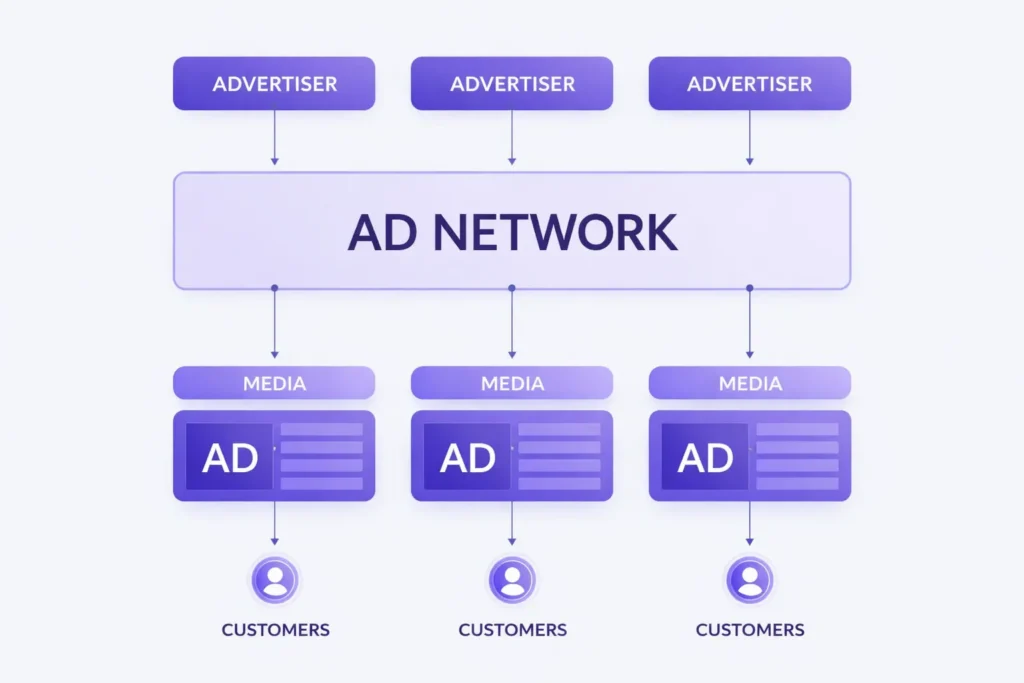
At its simplest, an ad network is a technology platform that sits between two parties. Specifically, on one side, advertisers want to place ads in front of the right audience. On the other side, publishers have digital real estate, such as website pages, app screens, or dApp interfaces, where those ads can appear.
The ad network aggregates available inventory from multiple publishers and packages it for advertisers. Instead of negotiating individual deals with dozens of sites, an advertiser accesses curated inventory through a single dashboard. Likewise, publishers gain access to a pool of advertisers without needing a dedicated sales team.
As a result, this aggregation model creates efficiency on both sides. Advertisers get scale. Publishers get consistent fill rates. Meanwhile, the network earns a margin by facilitating the transaction.
The Matching Process: From Impression to Ad Delivery
Here is what happens in milliseconds every time a user loads a page. First, the publisher’s site sends an ad request to the network. Then, the network evaluates available campaigns based on targeting criteria like geography, device type, user behavior, and content category. Finally, it selects the highest-value ad and delivers it to the user.
Modern networks rely on real-time bidding (RTB) to automate this selection. According to eMarketer, U.S. programmatic digital display ad spending exceeded $180 billion in 2025, representing roughly 92% of total digital display spending. Consequently, RTB allows multiple advertisers to bid on each impression simultaneously. This drives competition and pushes ad prices closer to true market value.
How Ad Networks Connect Advertisers and Publishers Through Targeting
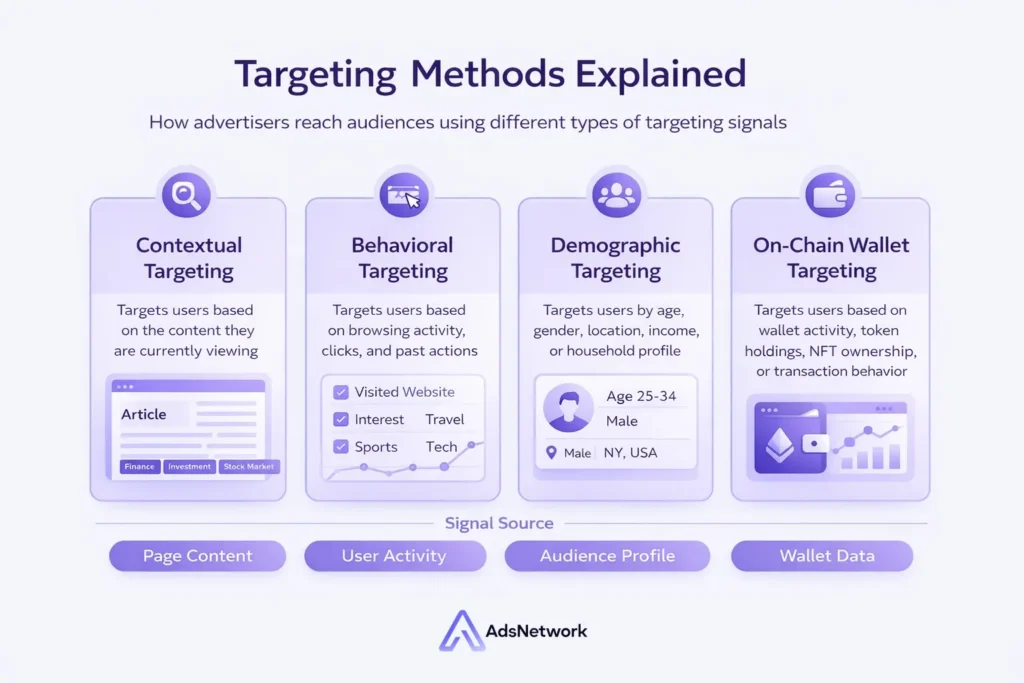
Targeting is where ad networks deliver the most value. Indeed, without it, advertising becomes a guessing game. Networks use several targeting methods to match the right ads with the right audiences.
For instance, contextual targeting places ads based on the content of the page. If a user reads an article about DeFi yield farming, the network serves ads related to decentralized finance. In contrast, behavioral targeting tracks user activity across sites to build interest profiles. Also, demographic targeting segments users by age, location, and device. Additionally, in Web3 advertising, on-chain targeting analyzes wallet data to identify users based on their blockchain activity, such as token holdings or DeFi interactions.
According to Marketing LTB, contextual targeting adoption grew two to three times between 2022 and 2025. Furthermore, behavioral audience segments still account for roughly 48% of programmatic spend. Therefore, the most effective campaigns combine multiple targeting methods. This layered approach helps advertisers avoid wasted impressions while also helping publishers command higher CPMs.
What Advertisers Gain from Ad Networks
Scale and Reach Without Direct Deals
Before ad networks existed, advertisers had to negotiate placements site by site. That model was slow, expensive, and impossible to scale. However, ad networks solved this by offering one-stop access to thousands of publishers. Today, as a result, a single campaign can reach audiences across hundreds of websites, apps, and platforms within minutes of launch.
For crypto and Web3 projects, this matters even more. Notably, mainstream platforms like Google and Meta impose strict restrictions on crypto advertising. Consequently, specialized crypto ad networks fill this gap by connecting blockchain projects with relevant publishers in the space. As noted by LKI Consulting, crypto ad spending is projected to exceed $12 billion in 2025. Therefore, specialized networks are becoming the primary channel for Web3 brands.
Performance Optimization and Budget Control
Ad networks give advertisers real-time dashboards to monitor impressions, clicks, conversions, and cost metrics. Moreover, most networks also offer automated optimization tools that shift budget toward higher-performing placements. This means less manual work and better return on ad spend.
In fact, retargeted ads alone increase conversion rates by 70%, according to Marketing LTB. Ad networks make retargeting possible at scale by tracking user journeys across their publisher pool. Then, they serve follow-up ads to users who showed initial interest.
What Publishers Gain from Ad Networks
How Ad Networks Connect Advertisers and Publishers to Monetize Content
For publishers, the primary benefit is monetization. Essentially, instead of leaving ad space empty, networks ensure inventory gets filled with paying ads. This is especially important for smaller publishers who lack the resources to sell ads directly. In addition, networks handle advertiser acquisition, billing, and ad delivery on the publisher’s behalf.
Fill rates matter because every unfilled impression is lost revenue. Specifically, premium networks consistently deliver fill rates above 90%. This means publishers earn on nearly every page view. Platforms like AdsNetwork focus specifically on connecting Web3 publishers with crypto-native advertisers. As a result, publishers in the blockchain space attract relevant, high-quality ad campaigns rather than generic display ads that their audience ignores.
Revenue Diversification and Higher CPMs
Working with multiple ad networks allows publishers to diversify their income. For example, header bidding technology lets publishers offer each impression to several networks simultaneously. This increases competition and drives CPMs higher. According to AdPushup, publishers using multiple ad networks and header bidding strategies see significantly improved revenue compared to relying on a single network.
Ad Networks vs. Ad Exchanges: Key Differences
Many people confuse ad networks with ad exchanges. However, they serve different functions. An ad network curates and bundles inventory before selling it to advertisers. It acts as a middleman that packages supply. In contrast, an ad exchange is an open marketplace where impressions are auctioned individually in real time.
As AdButler explains, ad exchanges offer more transparency because advertisers can see exactly which impressions they are bidding on. Nevertheless, ad networks provide simplicity and curation. For many advertisers, especially those new to digital campaigns, networks offer a lower barrier to entry.
In practice, the lines are blurring. Indeed, many modern ad networks integrate RTB functionality. This combines network curation with exchange-style auctions. Consequently, this hybrid model gives advertisers both convenience and granular control.
Real-World Examples: How Ad Networks Connect Advertisers and Publishers in Crypto
The Web3 advertising space offers clear examples of ad networks in action. Specifically, according to Blockchain-Ads, one published case study showed that Coinbase onboarded 31,000 new traders through their network. Additionally, another campaign for 5ire.org generated 3.84 million impressions, over 20,000 clicks, and 170 new token holders.
These results highlight what happens when targeting works correctly. Essentially, crypto ad networks use wallet-level data to identify users who already interact with blockchain protocols. Because of this precision, wasted spend drops and conversion rates improve compared to running generic display campaigns on mainstream platforms.
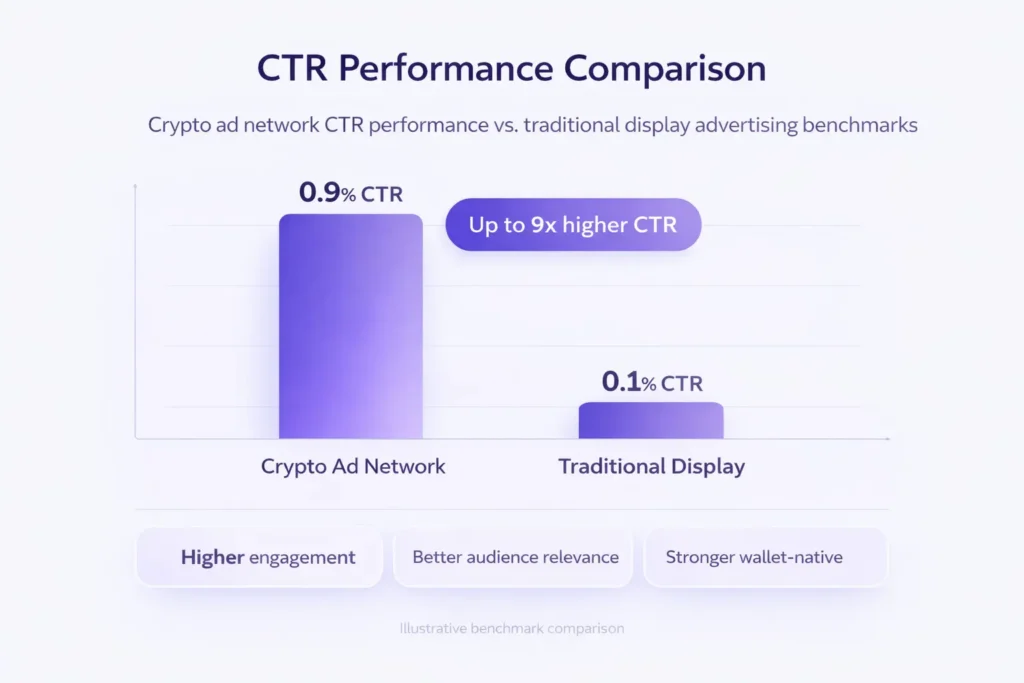
Similarly, Slise, a Web3-native ad platform, places ads directly inside decentralized applications. According to their published data, Slise achieves click-through rates of 0.3 to 0.4%. That is three to four times the industry average for standard display ads. Moreover, their network reaches over six million active crypto users at CPM rates below $10.
Challenges and How to Navigate Them
Ad networks are not without problems. Above all, transparency remains a top concern. Some networks operate as a black box. This means advertisers do not always know exactly where their ads appear. Likewise, publishers may not know which advertisers fill their inventory. This opacity can create brand safety issues.
Furthermore, ad fraud is another persistent challenge. According to Marketing LTB, 20 to 25% of programmatic impressions are at risk of fraud without proper verification tools. However, using fraud prevention technology can reduce invalid traffic by 60 to 90%.
For Web3 projects, blockchain-based ad networks offer a potential solution. For instance, platforms like AdEx use smart contracts to handle transactions between advertisers and publishers. As a result, every impression and payment is verifiable on-chain. This level of transparency is something traditional ad networks simply cannot match.
Working with a specialized network like AdsNetwork helps crypto projects avoid these pitfalls. By focusing exclusively on Web3 audiences, AdsNetwork reduces fraud risk and ensures brand-safe placements across vetted blockchain publishers.
How Ad Networks Connect Advertisers and Publishers: Key Takeaways
Ad networks remain the backbone of digital advertising. They aggregate supply from publishers, match it with advertiser demand through targeting and bidding algorithms, and deliver ads to the right users at the right time. For advertisers, networks provide scale, automation, and performance data. For publishers, they provide consistent revenue and access to premium campaigns.
In the Web3 space, specialized ad networks go further by using on-chain data and wallet targeting to reach crypto-native audiences. As digital ad spending continues to grow toward $850 billion by 2026, understanding how ad networks connect advertisers and publishers is no longer optional. It is a core skill for anyone building, marketing, or monetizing in the digital economy.
Ready to connect your Web3 project with premium crypto publishers? Explore how AdsNetwork simplifies advertising for blockchain brands at AdsNetwork.
Featured Posts

Oct 23, 2026
10 min read
What Is CPM in Advertising? Meaning, Formula and 2026 Rates
CPM is the cost an advertiser pays for 1,000 ad impressions, making it one of the most common…
Read Article
Sep 23, 2026
6 min read
What Is Advertising Technology (AdTech) and How Does It Work?
Advertising technology, commonly known as AdTech, refers to the software, platforms, tools, and systems used to plan, buy,…
Read Article
Sep 16, 2026
8 min read
Media Buying: A Complete Guide for Advertisers
Media buying is the process of purchasing advertising space to reach a target audience. It includes choosing where…
Read ArticleNeed Help?
Our team is ready to help you launch successful campaigns.
AI-Powered Mobile
Monitor Your Campaigns Anywhere
Stay connected to your live AdsNetwork campaigns with our mobile advertising app. Track impressions, clicks, conversions, campaign spend, and overall performance in real time—anytime, anywhere. Available for iOS and Android.